




Filter Research
Filter by Research Areas
Content Type
Featured Journal Article Read

Valuing the Global Mortality Consequences of Climate Change Accounting for Adaptation Costs and Benefits
The Quarterly Journal of Economics
This paper estimates that the release of an additional ton of carbon dioxide today will cause mean damages to global mortality risk valued at $36.6 under a high emissions scenario and $17.1 under a moderate scenario, using a 2% discount rate that is justified by US Treasury rates over the last two decades. It is a core input to the Climate Impact Lab's Data-driven Spatial Climate Impact Model (DSCIM).

Published November 1, 2022

Read

Journal Article Read
Climate and Conflict
Annual Review of Economics
Review of the current literature on climate and conflict and research priorities for the future.

Published September 12, 2015

Read
Report View
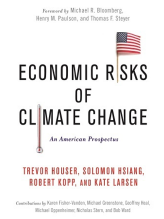
Economic Risks of Climate Change: An American Prospectus
Combines the latest climate models, state-of-the-art econometric research on human responses to climate, and cutting-edge private-sector risk-assessment tools to craft a game-changing profile of the economic risks of climate change in the United States.

Published August 9, 2015

Read
Journal Article Read
Convergence in Adaptation to Climate Change: Evidence from High Temperatures and Mortality, 1900-2004
American Economic Review
The difference in the heat-mortality relationship between hot and cold states declined over 1900-2004, though it persisted through 2004. The impact of extreme heat on mortality is notably smaller in states that more frequently experience extreme heat. Continuing differences in the mortality consequences of hot days suggests that health motivated adaptation to climate change may be slow and costly around the world.

Published May 1, 2015

Read
Journal Article Read
Using and Improving the Social Cost of Carbon
Science
The social cost of carbon (SCC) is a crucial tool for economic analysis of climate policies. The SCC estimates the dollar value of reduced climate change damages associated with a one-metric-ton reduction in carbon dioxide (CO2) emissions. Although the conceptual basis, challenges, and merits of the SCC are well established, its use in government cost-benefit analysis (CBA) is relatively new. In light of challenges in constructing the SCC, its newness in government regulation, and the importance of updating, we propose an institutional process for regular SCC review and revision when used in government policy-making and suggest how scientists might contribute to improved SCC estimates.

Published December 5, 2014

Read
Load More